




May 2026 Update — Three of the Four Pillars Crossed the Commercial Threshold
When this post first published in October 2025, “Light Logic” was a synthesis of four research areas that did not yet integrate into shipping systems. Seven months later, three of those four areas have crossed from research curiosity to commercial reality, and the fourth (gravity-mechanical storage) is undergoing a partial reshuffle as the iron-air and thermal-sand alternatives leapfrog pure-gravitational designs. This section updates the post against what actually shipped in late 2025 and early 2026.Pillar October 2025 thesis May 2026 reality Photonic compute Taichi chip (1000× efficiency, research) Q.ANT NPU 2 shipping via IONOS cloud; Lightmatter Passage L20 (6.4 Tbps optical engine); Lightelligence PACE2 PCIe accelerator card Ternary / sub-1-bit LLMs BitNet b1.58 (research preview) PrismML Ternary Bonsai 8B/4B/1.7B at 27 tok/s on iPhone 17 Pro Max, Apache 2.0; BitNet parallel kernels +1.15–2.1×; sub-1-bit BTC-LLM at 0.7–1.11 bits Quantum RNG ANU lab streams + IDQ enterprise modules Samsung Galaxy Quantum 6 ships QRNG in-pocket; AWS Marketplace msQRNG; Quantinuum Quantum Origin verifiable QRNG Sustainable storage Energy Vault + Gravitricity (pure gravity) Energy Vault commissions 25 MW / 100 MWh in China; Form Energy iron-air at 30 GWh (Google/Xcel) + 12 GWh (Crusoe AI); Polar Night sand-battery wins 2026 Popular Mechanics Breakthrough; Gravitricity entered voluntary liquidation Feb 2026
Photonic compute crossed the commercial threshold
The most consequential shift since October 2025 is that photonic AI compute is no longer a lab demonstration. Q.ANT’s NPU 2, announced 19 May 2026, is the first photonic AI accelerator commercially available via a mainstream cloud — IONOS — after pilot deployments at the Leibniz Supercomputing Centre (LRZ) and Forschungszentrum Jülich (JSC)[QANT-2026]. Q.ANT claims 30× lower energy and 50× higher performance per task than transistor baselines, and a 100× improvement over its own gen-1 part. That’s a research claim, not an independent benchmark, but the chip is now on a purchase order rather than in a paper.
Lightmatter’s Passage L20, announced March 2026, is a 6.4 Tbps-per-direction optical engine for near-package and on-board optics; samples late 2026[LIGHTMATTER-2026]. The headline claim — halving datacenter fibre counts via bidirectional multiplexing — is the kind of unglamorous infrastructure detail that decides whether photonic compute scales beyond pilot sites.
Lightelligence’s PACE2 launched at OFC 2026 as a PCIe accelerator card with ONNX/PyTorch/TVM compatibility[LIGHTELLIGENCE-2026]. The Hong Kong IPO filing in April 2026 suggests the financial side of photonic compute is catching up to the technical side.
Penn Engineering’s programmable diffractive deep neural network using rewritable metasurfaces — the kind of optical-fixed-pattern compute we described in the original post — was peer-reviewed in 2025 (PMC12518764)[PENN-2025]. Diffractive logic is now publishing in Nature Communications-family journals, not preprint servers.
What we don’t yet have is a head-to-head photonic-vs-Blackwell LLM-inference benchmark. The single best paper attempting one — PRISM (arXiv:2603.21576) — proposes O(1) photonic block selection for long context but stays theoretical.
Ternary went mainstream-portable
The post’s claim that ternary computing belongs on edge devices rather than datacenters was empirical aspiration in October 2025. PrismML’s Ternary Bonsai family, released April 2026, makes it empirically true: an 8B 1.58-bit model running at 27 tok/s on an iPhone 17 Pro Max and 82 tok/s on an M4 Pro, Apache 2.0 licensed, ~9× smaller than fp16 peers[BONSAI-2026]. The Ternary Bonsai 8B benchmark average of 75.5 is within striking distance of similarly-sized fp16 models. This is the first ternary release that a developer can pull from Hugging Face today and run on an off-the-shelf phone.
Microsoft’s January 2026 update to BitNet’s parallel kernels delivered a 1.15–2.1× speedup on the BitNet b1.58 2B-4T model across configurable hardware tilings[BITNET-2026]. Combined with the new sub-1-bit work — BTC-LLM at 0.7–1.11 bits via binary codebook plus learnable transform, keeping 0.8-bit LLaMA-2-13B within 3.1% of fp16 accuracy[BTC-LLM-2025]; HESTIA’s Hessian-guided quantization-aware training; TernaryLM’s 132M native-1.58-bit model with adaptive scaling — the trajectory is clearly toward production sub-1-bit deployment, not theoretical limits.
For the Light Logic vision, the upshot is that the ternary on the edge claim has been validated; what hasn’t been validated yet is ternary on photonic substrates. Bonsai runs on Apple’s M-series silicon (a transistor architecture); Q.ANT’s NPU 2 runs an optical matrix engine. Composing the two is still the open research problem.
Quantum RNG quietly commercialised
The post’s QRNG section described a small enterprise market. Seven months later, Samsung’s Galaxy Quantum 6 ships with IDQ’s 2.5×2.5 mm QRNG chipset — the smallest in production — integrated with Samsung Knox[SAMSUNG-2026]. QRNG is in millions of consumer pockets, not a niche enterprise SKU. The supporting infrastructure caught up at the same pace: Palo Alto Networks ships a vendor-agnostic QRNG Open API; AWS Marketplace lists msQRNG as a purchasable service; Quantinuum’s Quantum Origin offers verifiable QRNG from a fault-tolerant stack[QUANTINUUM-2025]. A 2025 peer-reviewed prototype of fully-integrated vacuum-based QRNG (arXiv:2505.01701) confirms that the silicon-photonics integration path is real.
In short: by mid-2026 there is no longer a tooling reason to seed a machine-learning pipeline with deterministic pseudo-randomness. The QRNG primitives the post described as a future component are an npm install away.
Gravity batteries — what to retire, what to foreground
This is the pillar that shuffled. Pure-mechanical gravity storage made significant progress and also took a significant casualty:
- Energy Vault commissioned the world’s first 25 MW / 100 MWh EVx system at Rudong, China in January 2026, in partnership with China Tianying and Atlas Renewable, with a second 100 MWh project signed for Huailai County, Hebei[ENERGY-VAULT-2026]. The thesis works at commercial scale.
- Gravitricity entered voluntary liquidation in February 2026 with under £8,000 in assets, with an IP sale deadline of 25 February 2026[GRAVITRICITY-2026]. The original post cited Gravitricity as an active competitor; that paragraph should now be read in past tense.
In the meantime, two non-gravity sustainable-storage approaches leapfrogged the pure-gravity competition for AI-datacenter deployments:
- Form Energy’s iron-air chemistry, which the original post mentioned only briefly, signed a 12 GWh deal with Crusoe for AI datacenters at CERAWeek March 2026, and a 30 GWh / 300 MW deal with Google and Xcel for a Minnesota project — described by the parties as the largest-by-GWh storage deal announced[FORM-GOOGLE-2026][FORM-CRUSOE-2026]. Form’s Weirton, WV factory is shipping.
- Polar Night Energy’s sand-battery design won the 2026 Popular Mechanics Breakthrough Award and starts a 250 MWh build at Vääksy in 2026; its sand-to-power electricity pilot tested early in 2026[POLAR-NIGHT-2026].
The honest read for the Light Logic vision: the sustainable-storage pillar is more diverse and more credible than the October 2025 post described, but the specific gravity-mechanical narrative is narrower than we expected. Future versions of this analysis should foreground Energy Vault as the gravity proof-point, retire Gravitricity, and treat Form Energy + Polar Night as parallel sustainable-storage options for AI compute loads.
Bonus — artisan and open-PDK silicon survived a near-death
The “hand-crafted computing” pillar of the original post depended on the open-PDK / shuttle-fabrication ecosystem that Tiny Tapeout and Efabless were building out. Efabless shut down in March 2025, briefly threatening that ecosystem. The recovery has been: the founders relaunched as ChipFoundry.io, restoring SKY130 PDK access; Tiny Tapeout pivoted to IHP (Leibniz Institute for High Performance Microelectronics) for its open-PDK shuttle, with a ~€300 dev-kit and €70/tile pricing[TINYTAPEOUT-2025]. The “artisan compute” thesis is less battered than it might have been; what got tested was the supply-chain resilience of the open-PDK movement, and it survived.
Mythic AI, the analog-compute company we mentioned, announced joint development with Honda in February 2026 on a 100×-energy-efficient analog AI chip for automotive SDVs, and a partnership with Microchip on memBrain-powered next-gen APUs targeting 120 TOPS/W[MYTHIC-2026]. Analog AI compute didn’t fade — it specialised into automotive.
What this update means for the original Light Logic vision
The original post described an integrated photonic-ternary-quantum-sustainable substrate as a 10–15 year horizon. Seven months later, the individual primitives have advanced enough that the integrated substrate is a 5–7 year horizon for some subset of the stack, with the photonic-ternary composition being the open research gap. The “Universal Basic Compute” social-contract framing remains a policy proposal, not an engineering reality. The infrastructure to make it concrete is closer than it was — meaningfully so on photonic compute, ternary edge inference, and quantum randomness; differently than expected on gravity storage; reconstituted-but-thinner on open-PDK silicon.
The vision still holds. The path to it is more vendor-mediated and less artisan than the original post hoped — but the components are no longer hypothetical.
The Vision: Computing for All
Imagine a world where computational power is as fundamental a right as education or healthcare. A world where bespoke, hand-crafted computers—built not in massive fabrication plants, but in local workshops—provide free computing resources as part of universal basic income. This isn’t science fiction. It’s the promise of Light Logic computing: a revolutionary synthesis of photonic circuits, ternary mathematics, quantum randomness, and gravity-powered energy storage.
For seventy years, computing has been locked into a binary paradigm—zeros and ones, on and off. But what if that was just a historical accident? What if computers could think in three states instead of two? What if they could process information at the speed of light using photons instead of electrons? And what if they could run on gravity batteries that store renewable energy without the environmental cost of lithium mining?
This is the vision behind Light Logic: a new computing paradigm that’s not just faster or more efficient, but fundamentally different—and radically more sustainable.
The Photonic Revolution: Computing with Light
Why Light Matters
Traditional electronic computers move electrons through silicon transistors. These electrons encounter resistance, generate heat, and hit fundamental physical limits as transistors shrink to atomic scales. Photonic computing sidesteps these limitations entirely by using photons—particles of light—to carry and process information.
The advantages are staggering:
- Femtosecond processing speeds: Where electronic chips operate in nanoseconds (billionths of a second), photonic chips compute in femtoseconds (quadrillionths of a second)—a million times faster
- Zero latency computation: Information processes while traveling, not after stopping and waiting like electronic signals
- Massive parallelism: Different wavelengths of light can carry multiple signals simultaneously through the same optical path without interfering
- Minimal heat generation: Photons don’t generate waste heat like electrons do
- Near-zero energy loss: Light travels through optical materials with virtually no resistance
Recent breakthroughs like the Taichi chip have demonstrated that photonic computing can achieve 1,000x better energy efficiency than Nvidia’s H100 GPUs while handling 14 million parameters—enough to run sophisticated AI models.
For an introduction to photonic computing fundamentals, see this video overview.
Light Logic Gates: Boolean Operations at Light Speed
In electronic computers, logic gates are built from transistors that switch between high and low voltage states. In photonic computing, we implement the same logical operations using light interference and diffraction.
Light Interference Logic: When two light waves meet, they can constructively interfere (amplify each other) or destructively interfere (cancel each other out). By carefully controlling the phase and amplitude of light waves, we can implement AND, OR, NOT, and other logic gates.
For example, a photonic AND gate works like this:
- Two input light beams enter an optical combiner
- The beams interfere constructively only when both inputs are “on” (high intensity)
- A micro-ring resonator filters the output, making a clear distinction between on/off states
- The result propagates to the next gate at the speed of light
Light Diffraction Logic: When light passes through specially engineered metasurfaces with precise patterns, it diffracts (bends) in controlled ways. By encoding information into light amplitude and directing it through diffraction layers, we can perform complex operations in parallel—with the logic “hardcoded” into the physical structure itself.
The beauty of combining both approaches, as demonstrated by the Taichi chip, is that diffraction handles fixed operations (like encoding data) while interference handles reconfigurable logic—giving us the best of both worlds.
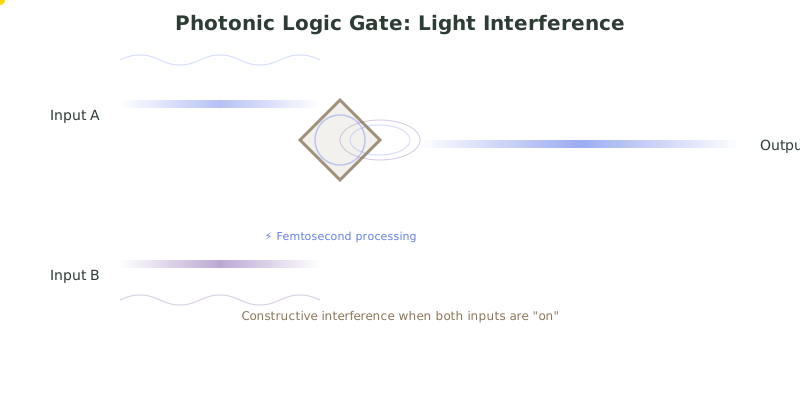
Diagram: Photonic logic gate operation showing wave interference and diffraction patterns. Based on Tsinghua University’s Taichi chip architecture and photonic computing principles from MIT’s integrated photonics research.
Ternary Logic: Three Is the Magic Number
The Binary Accident
Binary computing—based on two states (0 and 1)—wasn’t chosen because it was optimal. It was chosen because early computers used vacuum tubes and relays that had exactly two stable states: on or off. As Soviet engineer Nikolay Brusentsov discovered in the 1950s, this was a historical accident, not an engineering inevitability.
Brusentsov asked: What if computers could think in three states instead of two?
Enter Ternary: -1, 0, +1
In ternary (base-3) logic, each “trit” (ternary digit) can represent three values instead of two. The elegant choice is to use -1, 0, and +1 as the three states. This seemingly small change unlocks profound advantages:
Information Density: Each trit carries more information than a bit. With just 6 trits, you can represent 729 unique values (3^6), while 6 bits only give you 64 values (2^6). To match 6 trits, you’d need 10 bits—a 40% reduction in required digits.
Natural Negative Numbers: In binary, you need a separate “sign bit” to represent negative numbers. In balanced ternary (-1, 0, +1), negative numbers are built into the system. Subtraction is just as natural as addition—no special cases needed.
Simpler Arithmetic: Ternary AND gates have a beautiful property: they return the minimum of their inputs. If inputs are +1 and +1, output is +1. If inputs are +1 and -1, output is -1. This makes circuits simpler and more elegant.
40% Fewer Components: Research shows ternary chips require approximately 30-40% fewer transistors than equivalent binary circuits, translating directly to smaller chips, lower power consumption, and reduced manufacturing costs.
The Soviet Setun: Proof of Concept
In 1958, Brusentsov’s team unveiled the Setun, the world’s first ternary computer. Built with just 2,000 magnetic elements and 100 germanium transistors, it was 10 times cheaper than contemporary binary machines. About 50 units were manufactured and deployed to Soviet research institutions.
The Setun didn’t fail because the technology was flawed—it failed because the world had already standardized on binary. All the infrastructure, all the software, all the manufacturing processes assumed two states. Breaking that lock-in was politically and economically impossible in the Cold War era.
Modern Ternary Revival
Today, with new semiconductor materials like graphene and carbon nanotubes, ternary computing is experiencing a renaissance. These materials can naturally support multi-threshold devices that distinguish between three states with high reliability.
Huawei’s recent 7nm ternary chip demonstrates:
- 40% fewer devices for the same computational power
- 60% less power consumption
- 20% faster operation
The key breakthrough: transistors with two threshold levels instead of one, allowing clear differentiation between three distinct states: -1, 0, and +1.
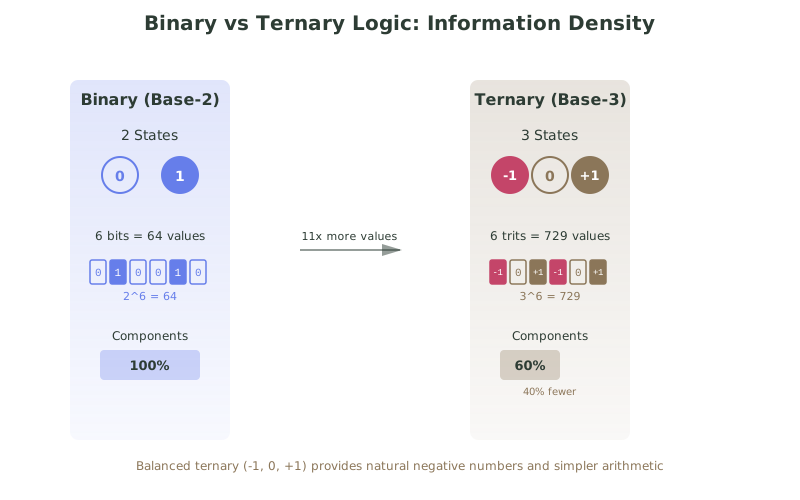
Diagram: Binary vs ternary logic comparison showing efficiency gains and information density improvements. Based on historical Setun computer design by Nikolay Brusentsov and modern ternary computing research from KAIST and Stanford University.
Further Reading: For a deep dive into ternary computing and the Soviet Setun computer, watch this excellent video explanation.
Quantum Random Numbers: True Uncertainty for Machine Learning
The Problem with Pseudorandom Numbers
Most computers generate “random” numbers using algorithms—deterministic processes that produce sequences that merely appear random. These pseudorandom numbers are perfectly fine for many applications, but they have a fatal flaw: they’re predictable if you know the algorithm and seed value.
For machine learning, this creates subtle problems:
- Reproducibility issues: The same seed produces the same “random” sequence, potentially introducing hidden biases
- Limited entropy: Pseudorandom generators can only produce as much randomness as their internal state allows
- Simulation limitations: When modeling quantum or chaotic systems, algorithmic randomness falls short
True Quantum Randomness
Quantum mechanics provides genuinely unpredictable randomness. When a quantum system is in a superposition state and you measure it, the outcome is fundamentally random—not just unknown to you, but unknowable in principle, even to the universe itself.
Light Logic systems can harness quantum randomness through several mechanisms:
Photon Shot Noise: When measuring low-intensity light, the exact timing and number of photons detected fluctuates due to quantum uncertainty. These fluctuations are truly random.
Beam Splitter Uncertainty: When a single photon hits a 50/50 beam splitter, quantum mechanics says it takes both paths simultaneously until measured. Which path it “chooses” is genuinely random.
Spontaneous Emission: Excited atoms emit photons at random times determined by quantum mechanics, not classical physics.
Python’s random() Function, Quantumly Enhanced
In a Light Logic system, Python’s random.random() function could tap into a hardware quantum random number generator:
# Traditional approach (pseudorandom)
import random
random.seed(42)  # Deterministic sequence
value = random.random()  # Predictable if seed is known

# Light Logic approach (quantum random)
import quantum_random  # Hardware interface to photonic QRNG
value = quantum_random.random()  # Genuinely unpredictable
For machine learning, this provides:
- Better initialization: Neural network weights initialized with true randomness avoid hidden bias patterns
- Stronger regularization: Quantum-randomized dropout provides more robust training
- Improved sampling: Monte Carlo methods and Bayesian inference benefit from true randomness
- Enhanced privacy: Differential privacy mechanisms gain stronger guarantees with quantum noise
The photonic nature of Light Logic systems makes quantum random number generation essentially “free”—it’s a natural byproduct of the optical measurement process, requiring no additional hardware.
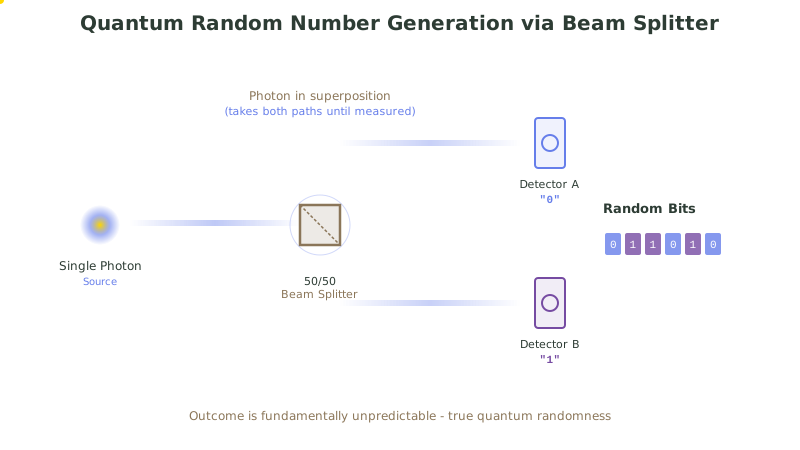
Diagram: Quantum random number generation process using photonic shot noise. Based on quantum optics principles and implementations from ID Quantique and Quintessence Labs commercial quantum RNG systems.
Gravity Batteries: Sustainable Power for Sustainable Computing
The Energy Storage Crisis
Renewable energy sources like solar and wind are variable—they produce power when nature provides, not necessarily when we need it. This creates a massive energy storage challenge. Traditional lithium-ion batteries have environmental costs: mining rare earth elements, limited lifespan (typically 5-10 years), and toxic disposal issues.
Gravity batteries offer a radically different approach: store energy by lifting heavy objects, then release it by lowering them. It’s ancient technology (think pendulum clocks from 1656), reimagined at massive scale.
How Gravity Batteries Work
The physics is beautifully simple. When you lift a mass against gravity, you store potential energy:
U = mgh
Where:
- U = potential energy
- m = mass (kg)
- g = gravitational acceleration (9.8 m/s²)
- h = height (meters)
To store 1 kWh of energy, you need to lift 1,000 kg about 367 meters (or equivalently, lift 10,000 kg about 37 meters).
When energy is needed, the mass descends, turning a generator to produce electricity—essentially “falling” energy.
Large-Scale Implementations
Pumped-Storage Hydroelectricity: The most common form. Water is pumped uphill to a reservoir when energy is abundant, then released through turbines when demand is high. The Dinorwig plant in Wales can store 9.1 GWh and deliver 1,728 MW—enough to power a small city.
Efficiency: 80-90% round-trip efficiency Lifespan: 50-100+ years (far longer than chemical batteries) Cost: $0.17/kWh levelized cost of storage
Solid Mass Systems: Companies like Energy Vault and Gravitricity are developing systems that lift concrete blocks or massive weights in abandoned mine shafts:
- Energy Vault: Cranes stack 35-ton concrete blocks in 110-meter towers, storing 25 MW/100 MWh
- Gravitricity: Underground shafts with 500-5,000-tonne weights, generating 10 MWh
Learn more about gravity battery technology in this detailed explanation.
Perfect Pairing with Light Logic Computing
Gravity batteries complement Light Logic systems beautifully:
Predictable Energy Availability: Unlike chemical batteries that degrade over time, gravity batteries provide consistent performance for decades. A Light Logic compute center powered by gravity storage can guarantee energy availability.
Zero Electronic Waste: No lithium, cobalt, or rare earths to mine or dispose of. Just water, concrete, or steel—materials we’ve worked with for centuries.
Local Energy Independence: Communities can build gravity battery systems using local materials and geography, matching the hand-crafted ethos of Light Logic computing.
Load Balancing: Light Logic systems have extremely low idle power consumption (photonic circuits don’t leak current like electronic ones). Gravity batteries can “trickle charge” from solar/wind, then provide burst power for computation when needed.
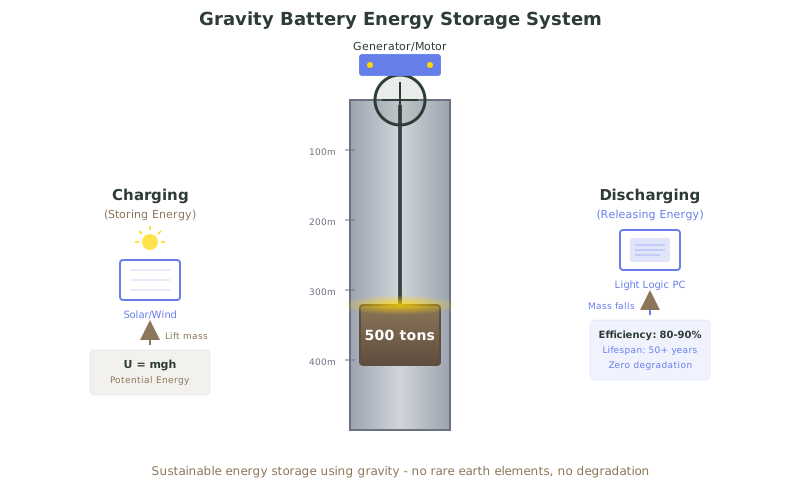
Diagram: Gravity battery energy storage system showing mechanical energy storage and retrieval. Based on Energy Vault’s gravity-based storage design and pumped hydroelectric storage principles adapted for modular deployment.
Hand-Crafted Computing: The Artisan Approach
Why Hand-Crafted?
The semiconductor industry is dominated by a handful of companies operating multi-billion-dollar fabrication plants. TSMC’s most advanced fabs cost over $20 billion to build. This centralization creates vulnerabilities: supply chain bottlenecks, geopolitical dependencies, and economic barriers to entry.
Light Logic systems enable a different path: hand-crafted, bespoke computers built in local workshops by skilled artisans.
Here’s why this works:
Photonic Components Are Macro-Scale: While electronic transistors are measured in nanometers (requiring extreme UV lithography), many photonic components operate at the scale of light wavelengths (hundreds of nanometers to micrometers). This is large enough to fabricate with less extreme equipment.
Optical Assembly: Lenses, mirrors, beam splitters, and optical fibers can be assembled manually with precision tools—similar to how high-end camera lenses are hand-assembled today.
Ternary Simplicity: With 40% fewer components than binary equivalents, ternary circuits are simpler to design and build, reducing the complexity barrier.
Modular Architecture: Light Logic systems can be built as chiplets—small, specialized modules combined into larger systems. Each chiplet can be crafted, tested, and certified independently.
The Economic Model
Local Fabrication: Communities establish Light Logic workshops—think of them as a blend of hackerspace, optical lab, and computer manufactory. Initial training and equipment costs are subsidized as infrastructure investment.
Craft Certification: Artisans undergo training in photonic assembly, ternary circuit design, and system integration. Certified builders maintain quality standards while preserving local variation and innovation.
Customization: Unlike mass-produced computers optimized for generic tasks, hand-crafted systems can be tailored:
- Research institutions get quantum-random-enhanced ML systems
- Educational settings get pedagogically designed architectures
- Local governments get privacy-optimized computation
Repair and Upgrade Culture: When you can see how your computer works—literally watching light flow through optical paths—repair and modification become feasible. This extends lifespan and reduces e-waste.
Carbon Nanotube Ternary Circuits
Recent research shows that carbon nanotube transistors are ideal for ternary logic because their switching characteristics naturally support multiple threshold levels. At 32nm feature size (achievable with less extreme lithography), CNT-based ternary chips show:
- 45% less area than binary equivalents
- 30% lower energy consumption
- Manufacturable with equipment 1-2 generations behind leading-edge fabs
This means local workshops with 2010s-era lithography tools could fabricate CNT ternary chips—lowering the barrier from $20 billion fabs to $100 million regional facilities.
Universal Basic Compute: A New Social Contract
The Parallel to Universal Basic Income
Just as Universal Basic Income (UBI) proposes that every person deserves a baseline income to meet their needs, Universal Basic Compute (UBC) proposes that every person deserves baseline computational resources.
In the 21st century, computing is no longer a luxury—it’s a necessity:
- Education: Online learning, research, skill development
- Economic Participation: Remote work, digital marketplaces, content creation
- Healthcare: Telemedicine, health monitoring, medical records
- Civic Engagement: Voting, advocacy, community organizing
- Social Connection: Communication, social networks, creative expression
When access to computing is mediated by commercial platforms that monetize user data and attention, digital participation comes with hidden costs: surveillance, algorithmic manipulation, and loss of autonomy.
The Light Logic UBC Model
Free Hardware: Every household receives a Light Logic terminal, manufactured in local workshops and powered by community gravity battery systems. These aren’t thin clients—they’re full computers capable of:
- Running machine learning models locally (no cloud dependency)
- Secure communication with quantum-encrypted channels
- Creative work (video editing, music production, 3D modeling)
- Educational software and research tools
Renewable Compute Credits: Like UBI provides monthly income, UBC provides monthly “compute credits”—guaranteed access to computing resources:
- Local computation on your terminal (unlimited)
- Shared community compute cluster (proportional allocation)
- Specialized resources (HPC, quantum simulation) by request
Privacy by Default: Because Light Logic systems process data locally and don’t require constant internet connectivity, user activity isn’t automatically surveilled. Photonic chips don’t inherently leak data the way cloud services do.
Open Architecture: The designs for Light Logic systems are open source. Anyone can learn how they work, modify them, and contribute improvements. This prevents vendor lock-in and empowers users.
Funding the Infrastructure
Energy Independence: Gravity batteries paired with local renewables mean communities aren’t paying for electricity from external grids. The marginal cost of computation drops to near zero.
Public Infrastructure Investment: Like roads, water systems, and electrical grids, UBC infrastructure is funded as a public good. Initial capital costs are high, but operational costs are minimal due to:
- Gravity battery longevity (50+ years)
- Photonic chip durability (no electronic degradation)
- Local fabrication (no shipping or markup)
Economic Multiplier: Providing free computing enables:
- Entrepreneurship: Anyone can start a digital business without upfront tech costs
- Education: Equal access to learning resources reduces inequality
- Innovation: More minds contributing to open-source projects
- Civic Participation: Informed citizens engaging with data-driven policy
Studies of UBI suggest every dollar invested returns $2-3 in economic activity. UBC has similar multiplier potential—perhaps even higher, given computing’s role in modern productivity.
Challenges and Considerations
Scaling Production: Building enough Light Logic systems for every household requires massive coordination. Initial rollout would target:
- Educational institutions (proof of concept)
- Underserved communities (highest impact)
- Research institutions (advanced users who can provide feedback)
Skill Development: Operating and maintaining photonic ternary systems requires new expertise. This creates jobs (training, fabrication, support) but also demands educational investment.
Software Ecosystem: Most software assumes binary architecture and commercial cloud services. Porting to ternary photonic systems requires:
- New compilers and operating systems
- Rewriting key libraries
- Developer education
This is a decades-long transition, not a switch-flip change.
Cultural Shift: UBC challenges the narrative that computational resources must be commercially mediated. Overcoming resistance from tech incumbents requires political will and public support.
The Road Ahead: Building the Future
Near-Term Milestones (2025-2030)
Photonic Ternary Proof-of-Concept: Universities and national labs build experimental Light Logic systems demonstrating:
- Ternary photonic logic gates
- Quantum RNG integration
- Gravity battery power delivery
- Basic ML workloads
Carbon Nanotube Fabrication: Regional fabs (not requiring leading-edge equipment) begin producing CNT-based ternary chips at 32nm, proving manufacturability outside TSMC/Intel monopoly.
Community Pilot Programs: Select communities receive prototype Light Logic terminals, providing real-world usage data and refinement feedback.
Medium-Term Goals (2030-2040)
Artisan Workshop Network: 100+ certified Light Logic fabrication workshops operating worldwide, each producing 1,000-10,000 units annually.
Open Source Ecosystem: Robust software stack including:
- Ternary-native operating system
- ML frameworks optimized for photonic hardware
- Development tools and languages
- Educational curricula
Gravity Battery Infrastructure: Co-located gravity storage at fabrication facilities and compute centers, demonstrating energy independence.
Policy Framework: Governments begin recognizing computational access as a human right, funding UBC infrastructure similarly to libraries or public schools.
Long-Term Vision (2040+)
Universal Deployment: Every household has access to Light Logic computing, either through owned terminals or community access points.
Global Knowledge Commons: Decentralized, locally-powered computing infrastructure enables:
- Privacy-preserving social networks
- Distributed scientific research
- Democratized AI development
- Cultural preservation and creation
Sustainable Computing: As electronic e-waste crisis deepens, Light Logic demonstrates an alternative path: durable, repairable, locally-sourced computing that works with physics rather than fighting it.
Conclusion: A Different Kind of Computer
Light Logic computing is more than a technical innovation—it’s a philosophical stance about what computers should be and who they should serve.
Instead of faster, it prioritizes sustainable. Instead of centralized, it champions local. Instead of proprietary, it insists on open. Instead of extractive, it embraces regenerative.
By combining the speed of photons, the elegance of ternary mathematics, the unpredictability of quantum mechanics, and the sustainability of gravity energy, Light Logic demonstrates that another computing paradigm is possible.
The binary, electronic, cloud-dependent model isn’t the only way—or even the best way. It’s just the way we happened to choose in the 1940s when vacuum tubes and wartime urgency drove design decisions.
Today, with climate crisis demanding sustainable technology, inequality demanding democratized access, and surveillance capitalism demanding alternatives, we have the opportunity—and the obligation—to choose differently.
Light Logic isn’t just about building better computers. It’s about building a better relationship between humanity and technology itself.
The light is ready. The mathematics is ready. The energy is ready.
Are we ready to build the future, one hand-crafted photonic circuit at a time?
Interested in contributing to Light Logic development? Divinci AI is collaborating with research institutions and community workshops to prototype these systems. Contact us to learn more about getting involved.
References
- Q.ANT. "Q.ANT Takes Photonic AI Computing Commercial as AI's Power Demand Surges." Press release, 19–20 May 2026. NPU 2 launch via IONOS cloud; deployments at LRZ + JSC. qant.com
- Lightmatter. "Lightmatter expands photonic-interconnect roadmap with Passage L20." Press release, 11 March 2026. 6.4 Tbps/direction optical engine. lightmatter.co
- Semiconductor Digest. "Lightelligence launches second-generation optoelectronic accelerated computing card." OFC 2026 coverage, 15–19 March 2026. PACE2 PCIe accelerator with ONNX / PyTorch / TVM support. semiconductor-digest.com
- Programmable diffractive deep neural networks enabled by integrated rewritable metasurfaces. Nature Communications-family peer review, PMC12518764, 2025. ncbi.nlm.nih.gov/pmc/articles/PMC12518764
- Prism ML. "Ternary Bonsai." Release announcement, 16 April 2026. 8B/4B/1.7B 1.58-bit family, Apache 2.0, MLX-native. prismml.com/news/ternary-bonsai; weights at huggingface.co/prism-ml
- Microsoft. "BitNet" repository update — parallel kernel configurations. January 2026. 1.15–2.1× speedup on BitNet b1.58 2B-4T. github.com/microsoft/BitNet
- BTC-LLM: Sub-1-bit LLM Quantization via Learnable Transformation and Binary Codebook. arXiv:2506.12040. 0.8-bit LLaMA-2-13B within 3.1% of fp16 accuracy. arxiv.org/abs/2506.12040
- ID Quantique. "Samsung Galaxy Quantum 6 — QRNG use case." 2.5×2.5 mm QRNG chipset integrated with Samsung Knox; world's smallest in production. idquantique.com
- Quantinuum. "Quantum Origin — verifiable QRNG from a fault-tolerant stack." Product page, 2025. quantinuum.com. Also: AWS Marketplace msQRNG listing.
- Energy Vault × China Tianying × Atlas Renewable. "25 MW / 100 MWh EVx commissioned at Rudong." Datacenter Dynamics, January 2026. Second 100 MWh signed for Huailai County, Hebei. datacenterdynamics.com
- Solar Power Portal. "Gravitricity wound up voluntarily with under £8k assets." February 2026. IP sale deadline 25 February 2026. solarpowerportal.co.uk
- Energy-Storage.news. "Google Minnesota data-centre energy deal includes 30 GWh multi-day iron-air batteries from Form Energy." March 2026. "Largest by GWh announced." energy-storage.news
- Form Energy. "Form Energy + Crusoe announce 12 GWh agreement for AI data centers." CERAWeek, March 2026. formenergy.com
- Polar Night Energy. "Sand battery wins Popular Mechanics Breakthrough Award 2026." Sand-to-Power electricity pilot testing early 2026; 250 MWh Vääksy build starts 2026. polarnightenergy.com
- eeNews Europe. "Tiny Tapeout sees industrial boost as it recovers from Efabless closure." Pivot to IHP (Leibniz Institute for High Performance Microelectronics), ~€300 dev-kit, €70/tile. 2025. eenewseurope.com
- Mythic AI. "Honda and Mythic announce joint development of 100× energy-efficient analog AI chip for next-generation vehicles." February 2026. Microchip memBrain partnership announced March 2026 targeting 120 TOPS/W. mythic.ai
Ready to Build Your Custom AI Solution?
Discover how Divinci AI can help you implement RAG systems, automate quality assurance, and streamline your AI development process.
Get Started Today